













Distance control in magnetic railways
In contrast to conventional railways, in magnetic railways the drive is not installed in the vehicle but in the track. In the Transrapid, wheels and rails of the conventional railway are replaced by a non-contact electromagnetic carrying, guiding and drive system. In contrast to conventional railways, in magnetic railways the drive is not installed in the vehicle but in the track. In the Transrapid, wheels and rails of the conventional railway are replaced by a non-contact electromagnetic carrying, guiding and drive system.
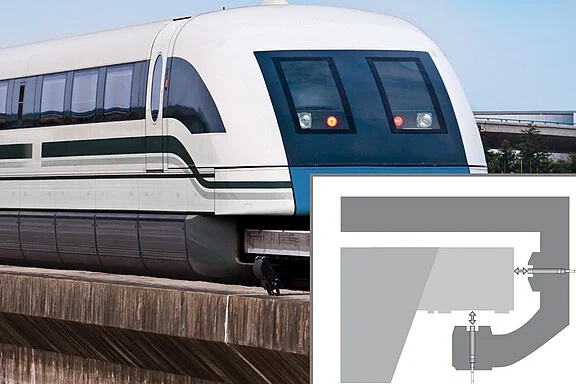
In contrast to conventional railways, in magnetic railways the drive is not installed in the vehicle but in the track. In the Transrapid, wheels and rails of the conventional railway are replaced by a non-contact electromagnetic carrying, guiding and drive system. In contrast to conventional railways, in magnetic railways the drive is not installed in the vehicle but in the track. In the Transrapid, wheels and rails of the conventional railway are replaced by a non-contact electromagnetic carrying, guiding and drive system.
Application challenge
In contrast to conventional railways, in magnetic railways the drive is not installed in the vehicle but in the track. In the Transrapid, wheels and rails of the conventional railway are replaced by a non-contact electromagnetic carrying, guiding and drive system.
Measurement method and system
In contrast to conventional railways, in magnetic railways the drive is not installed in the vehicle but in the track. In the Transrapid, wheels and rails of the conventional railway are replaced by a non-contact electromagnetic carrying, guiding and drive system.
The problem
In contrast to conventional railways, in magnetic railways the drive is not installed in the vehicle but in the track. In the Transrapid, wheels and rails of the conventional railway are replaced by a non-contact electromagnetic carrying, guiding and drive system.
The method
In contrast to conventional railways, in magnetic railways the drive is not installed in the vehicle but in the track. In the Transrapid, wheels and rails of the conventional railway are replaced by a non-contact electromagnetic carrying, guiding and drive system.