





















Lift height measurement in heavy-duty lifters
The supports on bridges must be renewed from time to time. The supports bear the weight of the bridge superstructure and absorb vibrations and expansions of the bridge. As the properties of the rubber bearings change over time, they must be replaced regularly. For such maintenance work, the bridge piers are lifted by 10 to 15 mm with heavy-duty lifters. After the maintenance work has been completed, the superstructure is lowered onto the new supports. When lifting bridges, it is important that the lifting process is absolutely synchronous so that no torsion forces can act on the bridge. Therefore, a draw-wire sensor is integrated in each heavy-duty lifter, which reports the current stroke to the control system. The supports on bridges must be renewed from time to time. The supports bear the weight of the bridge superstructure and absorb vibrations and expansions of the bridge. As the properties of the rubber bearings change over time, they must be replaced regularly. For such maintenance work, the bridge piers are lifted by 10 to 15 mm with heavy-duty lifters. After the maintenance work has been completed, the superstructure is lowered onto the new supports. When lifting bridges, it is important that the lifting process is absolutely synchronous so that no torsion forces can act on the bridge. Therefore, a draw-wire sensor is integrated in each heavy-duty lifter, which reports the current stroke to the control system.
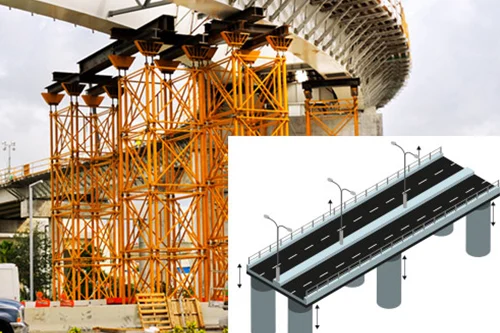
The supports on bridges must be renewed from time to time. The supports bear the weight of the bridge superstructure and absorb vibrations and expansions of the bridge. As the properties of the rubber bearings change over time, they must be replaced regularly. For such maintenance work, the bridge piers are lifted by 10 to 15 mm with heavy-duty lifters. After the maintenance work has been completed, the superstructure is lowered onto the new supports. When lifting bridges, it is important that the lifting process is absolutely synchronous so that no torsion forces can act on the bridge. Therefore, a draw-wire sensor is integrated in each heavy-duty lifter, which reports the current stroke to the control system. The supports on bridges must be renewed from time to time. The supports bear the weight of the bridge superstructure and absorb vibrations and expansions of the bridge. As the properties of the rubber bearings change over time, they must be replaced regularly. For such maintenance work, the bridge piers are lifted by 10 to 15 mm with heavy-duty lifters. After the maintenance work has been completed, the superstructure is lowered onto the new supports. When lifting bridges, it is important that the lifting process is absolutely synchronous so that no torsion forces can act on the bridge. Therefore, a draw-wire sensor is integrated in each heavy-duty lifter, which reports the current stroke to the control system.
Application challenge
The supports on bridges must be renewed from time to time. The supports bear the weight of the bridge superstructure and absorb vibrations and expansions of the bridge. As the properties of the rubber bearings change over time, they must be replaced regularly. For such maintenance work, the bridge piers are lifted by 10 to 15 mm with heavy-duty lifters. After the maintenance work has been completed, the superstructure is lowered onto the new supports. When lifting bridges, it is important that the lifting process is absolutely synchronous so that no torsion forces can act on the bridge. Therefore, a draw-wire sensor is integrated in each heavy-duty lifter, which reports the current stroke to the control system.
Measurement method and system
The supports on bridges must be renewed from time to time. The supports bear the weight of the bridge superstructure and absorb vibrations and expansions of the bridge. As the properties of the rubber bearings change over time, they must be replaced regularly. For such maintenance work, the bridge piers are lifted by 10 to 15 mm with heavy-duty lifters. After the maintenance work has been completed, the superstructure is lowered onto the new supports. When lifting bridges, it is important that the lifting process is absolutely synchronous so that no torsion forces can act on the bridge. Therefore, a draw-wire sensor is integrated in each heavy-duty lifter, which reports the current stroke to the control system.
The problem
The supports on bridges must be renewed from time to time. The supports bear the weight of the bridge superstructure and absorb vibrations and expansions of the bridge. As the properties of the rubber bearings change over time, they must be replaced regularly. For such maintenance work, the bridge piers are lifted by 10 to 15 mm with heavy-duty lifters. After the maintenance work has been completed, the superstructure is lowered onto the new supports. When lifting bridges, it is important that the lifting process is absolutely synchronous so that no torsion forces can act on the bridge. Therefore, a draw-wire sensor is integrated in each heavy-duty lifter, which reports the current stroke to the control system.
The method
The supports on bridges must be renewed from time to time. The supports bear the weight of the bridge superstructure and absorb vibrations and expansions of the bridge. As the properties of the rubber bearings change over time, they must be replaced regularly. For such maintenance work, the bridge piers are lifted by 10 to 15 mm with heavy-duty lifters. After the maintenance work has been completed, the superstructure is lowered onto the new supports. When lifting bridges, it is important that the lifting process is absolutely synchronous so that no torsion forces can act on the bridge. Therefore, a draw-wire sensor is integrated in each heavy-duty lifter, which reports the current stroke to the control system.