










Synchronization monitoring with draw-wire sensors in telescopic platforms
For electronic synchronization monitoring, a draw-wire sensor is used here. These are easy to integrate, very compact and offer high accuracy in addition to the large measuring range. For displacement measurement, the sensor is mounted on the lowest cylinder tube of the telescopic cylinder with the opening facing downwards. This prevents dirt or liquids from getting into the inside of the sensor. The steel cable with wire extension is guided from the sensor via deflection pulleys into the cylinder tube. For electronic synchronization monitoring, a draw-wire sensor is used here. These are easy to integrate, very compact and offer high accuracy in addition to the large measuring range. For displacement measurement, the sensor is mounted on the lowest cylinder tube of the telescopic cylinder with the opening facing downwards. This prevents dirt or liquids from getting into the inside of the sensor. The steel cable with wire extension is guided from the sensor via deflection pulleys into the cylinder tube.
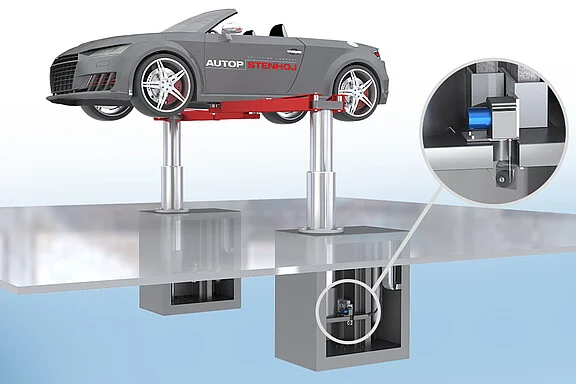
For electronic synchronization monitoring, a draw-wire sensor is used here. These are easy to integrate, very compact and offer high accuracy in addition to the large measuring range. For displacement measurement, the sensor is mounted on the lowest cylinder tube of the telescopic cylinder with the opening facing downwards. This prevents dirt or liquids from getting into the inside of the sensor. The steel cable with wire extension is guided from the sensor via deflection pulleys into the cylinder tube. For electronic synchronization monitoring, a draw-wire sensor is used here. These are easy to integrate, very compact and offer high accuracy in addition to the large measuring range. For displacement measurement, the sensor is mounted on the lowest cylinder tube of the telescopic cylinder with the opening facing downwards. This prevents dirt or liquids from getting into the inside of the sensor. The steel cable with wire extension is guided from the sensor via deflection pulleys into the cylinder tube.
Application challenge
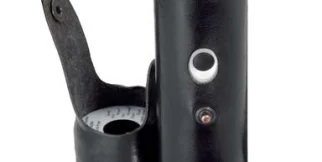
For electronic synchronization monitoring, a draw-wire sensor is used here. These are easy to integrate, very compact and offer high accuracy in addition to the large measuring range. For displacement measurement, the sensor is mounted on the lowest cylinder tube of the telescopic cylinder with the opening facing downwards. This prevents dirt or liquids from getting into the inside of the sensor. The steel cable with wire extension is guided from the sensor via deflection pulleys into the cylinder tube.
Measurement method and system
For electronic synchronization monitoring, a draw-wire sensor is used here. These are easy to integrate, very compact and offer high accuracy in addition to the large measuring range. For displacement measurement, the sensor is mounted on the lowest cylinder tube of the telescopic cylinder with the opening facing downwards. This prevents dirt or liquids from getting into the inside of the sensor. The steel cable with wire extension is guided from the sensor via deflection pulleys into the cylinder tube.
The problem
For electronic synchronization monitoring, a draw-wire sensor is used here. These are easy to integrate, very compact and offer high accuracy in addition to the large measuring range. For displacement measurement, the sensor is mounted on the lowest cylinder tube of the telescopic cylinder with the opening facing downwards. This prevents dirt or liquids from getting into the inside of the sensor. The steel cable with wire extension is guided from the sensor via deflection pulleys into the cylinder tube.
The method
For electronic synchronization monitoring, a draw-wire sensor is used here. These are easy to integrate, very compact and offer high accuracy in addition to the large measuring range. For displacement measurement, the sensor is mounted on the lowest cylinder tube of the telescopic cylinder with the opening facing downwards. This prevents dirt or liquids from getting into the inside of the sensor. The steel cable with wire extension is guided from the sensor via deflection pulleys into the cylinder tube.